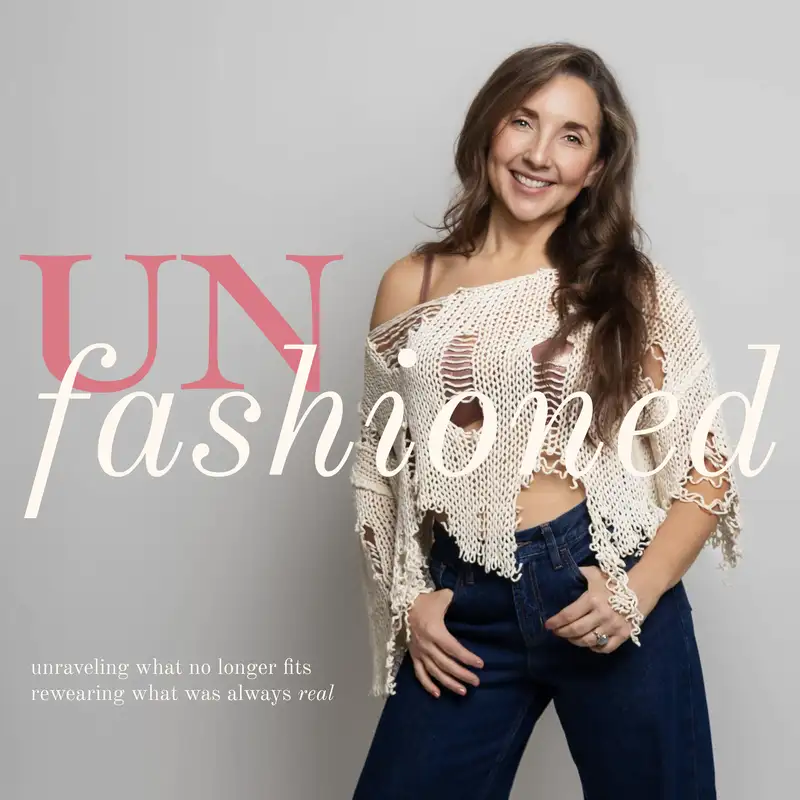
SEASON 2 W'26 - STORY 4 The Fabric I Wove
00:00:09 Welcome: Hi, I'm Melanie and this is UNfashioned. A podcast about unravelling what no longer fits and re-wearing what was always real. Today is actually my forty-sixth birthday. Birthdays used to feel like milestones I had often used to measure myself against and compare myself to. I would quietly calculate where I should be and whether I had become enough yet to match the milestones. I treated each year like a checkpoint that required proof. But this birthday feels different. There's no dramatic music playing or some kind of reinvention montage. It's just me standing here in the exact body on this exact day, noticing what feels true for me. It feels like I'm running my hands over a body of well made fabric and realizing how well it has held up over time. It is held up through pressure, through movement, through seasons of strain and seasons of ease. It has not remained untouched, but it has remained intact. And that realization feels more meaningful to me than any milestone achievement. Because before we strive to become structured or stylish or admired from a distance, we begin as fabric, as fiber, as threads that are woven and tested. At forty-six, I am less concerned with how my life appears and more aware of what is what it is constructed from. I think about what strengthened me, what thinned me, and what stretched me beyond comfort and what nearly tore me apart. This birthday does not feel like a comparison to milestones. It feels like understanding the weave of who I am and recognizing how it has lasted over the years. It feels more like knowing the importance of my own composition. And that is what this story is about. The fabric.
00:02:31 Natural vs. Synthetic: Today, I stood in front of my closet and began touching all the garments hanging in there. The cotton felt comfortable and honest. The linen carried a slight texture, imperfect and breathable. The silk slip through my fingers with soft strength. These natural fibres begin in the earth. Cotton grows in open fields and is cleaned, spun and woven. Linen comes from flax that is pulled from the ground. Silk begins as a single filament, spun by a silkworm and made into something both beautiful, delicate and incredibly strong. They begin alive. They respond because they once responded to wind, heat, rain, and time. They wrinkle under pressure, they soften with wear they stretch slightly and then settle. They breathe because they never were sealed off from the world. There was a time in my life when I was like that. Open and reactive. In my twenties, in art school, expression felt free. I spent long nights in the studio, surrounded by my sketches, unfinished ideas and conversations that stretched past midnight. I was not trying to project a finished version of myself. I was just trying to expand. Knowledge and experimentation mattered. Changing my mind felt intelligent, not unstable. I let new ideas alter the direction I was heading. Evolving did not feel threatening. It felt inevitable. Natural fibers respond to their environment. They shift, soften, and carry marks of experience. And that's how I lived then. On the other side of my closet were the garments made from polyester and acrylic. Synthetic fibers are engineered, not grown. Polyester begins as petroleum pulled from the earth, melted down and forced through spinnerets into long, continuous filaments, then chemically treated for strength and durability. Acrylic is formed through polymerization in controlled environments, built molecule by molecule to resist decay and maintain shape. It is designed to endure friction. To resist wrinkles. It repels moisture. It holds color under harsh light. It does not change much with wear. Survival is synthetic and living is natural both in fabric and in life. There were years when survival mattered more to me. I was open to what society considered important and reacted in a manner that followed that importance. I was easily marked by these experiences and sometimes felt wrinkled by them. I became structured and held my shape. I resisted showing strain. At thirty, I could tolerate the scratchy, unbreathable synthetic version of myself as long as it looked impressive. I could override discomfort and call it ambition. I could stay in environments that felt airless because endurance felt like strength. Now here at forty-six, my body refuses what suffocates it. If something traps heat, I feel it immediately. If something irritates me, I do not negotiate with it. It will not remain in my closet, just as I remove other parts of life that have tried to suffocate me. I can feel when I am in something organic and natural, and when I'm in something manufactured. I can tell when I am responding naturally and when I'm engineered to perform. Both kinds of fabric exist in my closet for a reason. But I am no longer willing to live entirely as something constructed and controlled. Because durability without breath is not wholeness. And I am learning slowly to choose what lets air in.
00:07:19 The Weave: Fabric is created when threads cross each other with intention. One set is pulled tight and anchored in place. The other moves through it, over and under, back and forth until something flexible and strong begins to form. No single thread becomes cloth on its own. It is the crossing that creates structure. When I look at my life, I can see that it was never built in straight lines. It was built in intersections. The thread of being an artist was pulled tight early. It gave me framework. It taught me to see construction beneath the surface. It trained my eye to understand the process of how things are put together, and why some pieces endure while others fall apart. Then motherhood moved through that structure and change the pattern completely. It softened some parts of me and strengthened others. It demanded flexibility in places that once had been rigid. It added depth to the weave. Love entered and rewoven sections I thought were fixed. Some strands tightened under passion, some frayed under disappointment. Each relationship altered the tension of the cloth. Running a business wove in resilience, financial uncertainty, creative risk, public visibility and private doubt. Those threads pulled hard, sometimes almost snapping, but they reinforced the structure in ways comfort never could. Heartbreak became a thread. Reinvention became a thread. I used to think my life was a series of chapters that replaced one another. Now I understand that nothing was replaced. Everything is interlaced. The athlete in me strengthened the mother. The artist in me challenged the business owner. The vulnerable woman reshaped the strong one. Every crossing added dimension. Some intersections were gentle and some created knots. I had to work loose over time. But the fabric formed anyway. At this age, I can feel the density of it. I am not a collection of roles stacked on top of each other. I am a woven fabric shaped by every tension, crossing and season that pulled in a different direction. The strength of the fabric is not just one strand. It is in the weave.
00:10:12 Stretch & Recovery: Not all fabric responds to tension the same way. Just the way not all people respond to tension in the same way. Woven cloth is strong because its threads are locked into place. It holds structure beautifully, but does not naturally stretch. When pressure comes, it either resists or tears. Knit fabrics are built differently. Its threads loop into one another, creating give. It expands with movement and settles back when the body rests. Then there is spandex. Spandex is rarely the star of a garment, but even a small percentage changes everything. It allows the fabric to extend far beyond its original shape and, more importantly, return. Returning to its original shape is the part that matters. Life has stretched me in ways I did not anticipate. Motherhood stretched me overnight. My body stretched and changed. My identity shifted. There was no gradual easing into it. One day I was one woman; and the next day I was responsible for someone else's entire existence. Building my business stretched me in financial risk and visibility, the pressure to sustain something I loved without letting it consume me. I learned to hold steady even when I felt uncertain. Love stretched me differently. Opening my heart after disappointment required expansion I did not always feel prepared for being vulnerable is elastic; it asks you to extend beyond safety. Even my body has stretched in mid-life. Hormones shifting. Muscle strengthening. Pushing weight in CrossFit and realizing that growth often comes from controlled strain. Responsibility tightened certain threads until they held firm. Ambition pulled others taut across the frame. Caretaking wove in softer fibers and changed the texture entirely. Reinvention unraveled sections I thought were permanent and reworked them into something stronger. For years, I thought stretching was the measure of resilience. But stretching without recovery leaves distortion. There were seasons when I stayed extended too long, when I held everything together and did not fully come back to myself. When I told myself I was strong, but I was actually thin. At forty-six, I am more interested in recovery than performance. Elasticity, like spandex, is not a weakness. It is intelligence. Do I rest after effort? Do I recover to my center after a conflict? Do I allow joy to refill what stress has drained? Like in spandex, a small percentage of stretch can protect the entire structure. I am learning to build that stretch in my life. Boundaries have become my spandex. Rest has become my recovery. Saying no has become my release that allows me to return to myself. Stretch is inevitable. Recovery is chosen. And now I am always choosing to come back to myself.
00:13:59 Under Tension And Repair: Fabric does not tear the first time it is pulled. It holds its shape and redistributes the strain so that the surface still appears intact. The seams tighten, the weaves shift, and the pressure becomes part of the structure. There was a season in my life when I lived exactly that way. I became a person who absorbed tension. When something felt unstable, I stepped into steady it. When something felt overwhelmed, I carried more than my share. I believe that strength meant preventing rupture, and I quietly took pride in being the one who could keep everything together. Being "the mom in the situation" felt natural to me. I anticipated what others needed before they voiced it. I managed emotions that were not mine. I reinforced weak spots in relationships and work before they became visible. From the outside, everything looked intact. What I did not recognize at the time was how tightly I was being pulled. Fabric under constant tension begins to thin long before it tears and the threads separate slightly and the density changes even though the garment still functions. I began to feel that thinning in myself. I was still performing steadiness, but I was exhausted in the way that sleep could not correct. I felt irritable in moments that did not warrant it. I noticed a quiet resentment growing where generosity once lived. I had mistaken endurance for resilience, and that difference mattered. Eventually, something had to happen. It was a boundary I finally voiced. It was a refusal to take on more. It was the recognition that holding everything together was costing my integrity. When fabric tears, it presents a choice. You can discard it and decide it's ruined. You can hide the damage and pretend it never happened or you can repair it. Repair requires attention. You align the edges carefully and you stitch with care. You reinforce the underside so that the next strain is distributed differently. The repaired area is never identical to the original construction, but it is often stronger because it is reinforced. There are places in my life that have been repaired in this way. I have restitched boundaries that once frayed. I reinforced self respect after it was thinned. I have rebuilt trust differently than before with the more awareness of tension and capacity. The tear did not end the fabric of my life. It altered the weave. At forty-six, I no longer measure myself by how much strain I can withstand. I pay attention to pull sooner. I release tension early, and when something tears, I mend it without shame. Fabric that has been repaired carries a lot of history and so do I.
00:17:43 Back to the Closet: Standing in my closet now feels different than it used to. I slide the hangers apart and press the fabric between my fingers. Each material carries a story about how I was made and how it has been worn. Some fibers have softened because they were allowed to breathe. Some have thinned where they were pulled too tightly, and some have been stitched back together and now hold in a new way. When I stand there now, I'm not just choosing what to wear. I'm noticing what feels aligned in my life. There was a time when I chose structure over comfort and durability over honesty. I believed I had to hold my shape no matter the pressure. I mistook rigidity for strength. Now, I understand that breath matters more than polish. I understand that fabric is meant to move. The closet has become less about clothing and more about awareness. It is a place where I can feel the difference between what constricts and what allows space. It is where I practice choosing what supports the structure of who I am, instead of forcing myself into something that demands performance. I no longer expect myself to be untouched. I expect myself to be real. At forty-six, I know that my life is not meant to look brand new. It is meant to be lived in. It is meant to carry evidence of tension and repair. It is meant to hold memory in its fibers. I am not searching for a new identity to step into. I am choosing what honors the weave that already exists. And when I ask myself what I'm made of, the answer is no longer about appearance. It's about the fabric.
00:19:50 Listener Reflection: If you are somewhere quiet right now, take a moment to slow down. If you can, walk to your closet and stand there without rushing. Slide the hangers apart and let your hand rest on whatever fabric you touch first. Do not analyze it, just feel it. Notice the texture against your skin. Notice whether it feels cool or warm, soft or structured, light or dense. Pay attention to your body's response before your mind names the material. The body always knows. There are places in your life that feel breathable and easy. There are places that feel tight and structured. There may be areas that have thinned from carrying too much for too long. There may be seams that have already been repaired and now hold differently than before. Strength and softness can exist at the same time. Durability and sensitivity are not opposites. They are fibers woven together. Stand there long enough to notice what feels honest. Notice where you are rigid, out of habit. Notice where you are soft without apology. Notice where you might need reinforcement and where you might need release. You are not required to remain under constant tension. You are allowed to breathe and let yourself feel the difference. You are allowed to choose the fabric of your own life.
00:21:35 Closing: This season of UNfashioned is an invitation to look beneath the surface, to slow down and understand how something is made before deciding how it fits. We have turned the garments inside out. We've examined labels, tension, repair, and now the fabric itself. Each layer reveals something about endurance, softness, strain, and the quiet ways we hold. This episode was about fabric, about the fibres that run through you and the weave that formed over time. It was about recognising where you have stretched, where you have thinned, and where you have chosen to mend instead of discard. Fabric is the foundation. It is what everything else depends on. New episodes of UNfashioned are released biweekly, giving each story room to settle and the space to live alongside it. I'm Melanie and this is UNfashioned. Until next time, be proud of the fabric you have woven from your own life.